
Compare 316 vs 304 stainless steel to learn key differences in corrosion resistance strength cost and best uses for your project.
The Basics: What Are 304 and 316 Stainless Steel?
When people talk about stainless steel, 304 and 316 are two of the most common grades you’ll hear about. Both belong to the austenitic stainless steel family, known for their excellent corrosion resistance, durability, and versatile use. Austenitic steels are defined by their crystal structure, which is face-centered cubic, giving them great toughness even at low temperatures.
Historical Context and Development
304 stainless steel was developed in the early 20th century and became popular for general-use applications due to its balance of strength, corrosion resistance, and affordability. Later, 316 was introduced with a slight chemical tweak to handle harsher environments, especially where exposure to saltwater or chemicals is common.
Chemical Composition Breakdown
The main difference between the two lies in their chemical makeup, affecting their performance and price. Here’s a quick look at the elemental percentages in both:
| Element | 304 Stainless Steel (%) | 316 Stainless Steel (%) |
|---|---|---|
| Chromium (Cr) | 18 – 20 | 16 – 18 |
| Nickel (Ni) | 8 – 10 | 10 – 14 |
| Carbon (C) | ≤ 0.08 | ≤ 0.08 |
| Manganese (Mn) | ≤ 2 | ≤ 2 |
| Molybdenum (Mo) | 0 | 2 – 3 |
| Phosphorus (P) | ≤ 0.045 | ≤ 0.045 |
| Sulfur (S) | ≤ 0.03 | ≤ 0.03 |
The molybdenum content in 316 is the key player, boosting its corrosion resistance, especially against chlorides and marine environments. This makes 316 the go-to for tougher conditions.
Both grades share chromium and nickel, which make them food grade stainless steels suitable for various industries.
Next, we’ll dive into the key differences in their performance to help you understand when to pick one over the other.
Key Differences: Breaking Down Performance Head-to-Head
When comparing 316 vs 304 stainless steel, the differences really show up in how they handle corrosion, strength, welding, heat, and looks. Here’s a quick rundown:
Corrosion Resistance Advantages
- 316 stainless steel contains molybdenum, which boosts its resistance to chlorides and salt — great for marine environments and chemical exposure.
- 304 stainless steel does well in general corrosion resistance but isn’t as strong against pitting from salt or harsh chemicals.
Mechanical Properties Comparison
| Property | 304 Stainless Steel | 316 Stainless Steel |
|---|---|---|
| Tensile Strength | ~73,000 psi | ~80,000 psi |
| Yield Strength | ~30,000 psi | ~31,000 psi |
| Hardness | 70 HRB | 85 HRB |
316 offers slightly better strength and hardness than 304, making it a better pick where durability counts.
Weldability and Heat Resistance
- Both grades weld well with standard techniques, but 316 is better when you need resistance to higher temperatures (up to 1500°F), thanks to its composition.
- 304 can handle heat well up to about 1400°F, suitable for most kitchen and industrial uses.
Aesthetics and Finish Differences
- Both grades have a similar shiny, smooth finish when polished but 316 tends to maintain its luster longer in harsh outdoor conditions.
- For indoor or decorative use, 304’s finish looks just as good and often costs less.
Quick Comparison Table: 316 vs 304
| Feature | 304 | 316 |
|---|---|---|
| Corrosion Resistance | Good (general) | Excellent (marine grade) |
| Molybdenum Content | 0% | 2-3% |
| Tensile Strength | ~73,000 psi | ~80,000 psi |
| Weldability | Easy | Easy |
| Heat Resistance | Up to 1400°F | Up to 1500°F |
| Visual Longevity | Good | Better outdoors |
In short, 316 stainless steel is your go-to when corrosion resistance and strength in tough environments matter most. But 304 holds its own where costs and good performance meet.
Cost Analysis: Is 316 Worth the Premium Over 304?
When deciding between 316 vs 304 stainless steel, cost often plays a big role. 316 usually costs more because it contains molybdenum—a metal that boosts corrosion resistance, especially against chlorides and saltwater. That extra ingredient pushes the price up by about 20-30% compared to 304.
But don’t just look at the upfront price. The total ownership cost can tell a different story. For example:
- In marine or chemical environments, 316 resists rust and damage longer, reducing repair or replacement expenses.
- With 304, you might save initially but face higher maintenance or earlier failure in harsh conditions.
If your application involves lower exposure to chlorides or acid, 304 could save you money without sacrificing performance. Also, buying 316 in bulk often helps bring down the cost per pound, which is smart for bigger projects.
When to pick 304 to save money:
- Indoor applications with low corrosion risk
- Food processing equipment that doesn’t involve harsh chemicals
- General kitchen appliances and home use
In , 316 is worth the premium when corrosion resistance and longer life matter most. Otherwise, 304 remains a solid, budget-friendly choice for less demanding environments.
Applications: Where Each Grade Shines (and Where It Doesn’t)
304 Common Uses and Case Studies
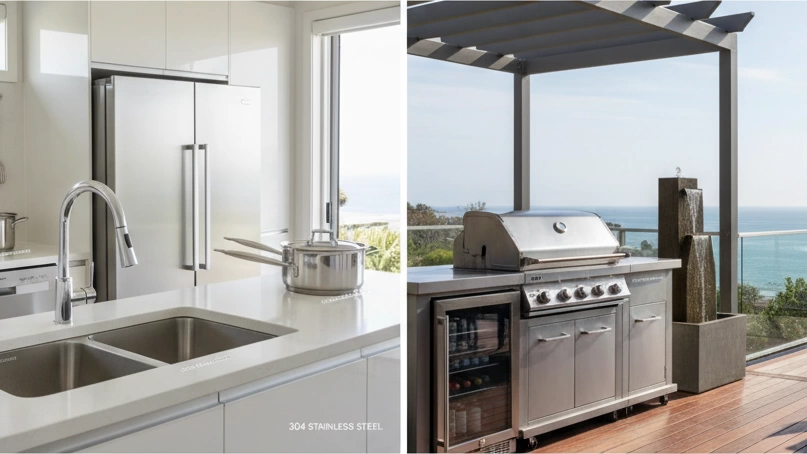
304 stainless steel is the go-to choice for everyday applications where corrosion resistance is needed but the environment isn’t too harsh. You’ll find 304 used in kitchen equipment, food processing, appliances, and indoor architectural elements. For example, many commercial kitchens in the U.S. rely on 304 for sinks, counters, and cookware because it’s food grade, easy to clean, and affordable. It’s also common in HVAC components and automotive trim where moderate corrosion resistance is enough.
316 Prime Applications and Case Studies
316 stainless steel is better suited for tougher conditions, especially where saltwater or chemicals are involved. It’s famously known as marine grade stainless steel, widely used in boat fittings, coastal architecture, and medical equipment that requires the highest corrosion resistance. In the U.S., coastal construction and pharmaceutical plants often choose 316 to keep materials safe from chloride pitting and rust. For instance, a commercial oyster farming operation might use 316 steel cages to withstand constant saltwater exposure.
Hybrid Usage Scenarios
In some projects, mixing 304 and 316 makes sense. For example, structural frames indoors might use 304, while exposed parts near the ocean or in chemical plants are upgraded to 316. This approach balances cost and performance, giving you durability where it counts without shelling out premium prices everywhere.
Emerging Trends in Sustainability
Both 304 and 316 stainless are recyclable, making them eco-friendly choices. But 316’s durability means less frequent replacement, which adds to sustainability in industries like renewable energy and water treatment. As green building codes evolve in many U.S. states, you’ll see more demand for stainless steel grades that last longer and reduce waste — a trend favoring 316 in harsh environments.
Pros and Cons: A Balanced View for Decision-Makers
When choosing between 316 vs 304 stainless steel, weighing the pros and cons is essential to find the right fit for your project.
304 Pros and Cons
Pros:
- More affordable and widely available in the U.S. market
- Good corrosion resistance for most indoor and mild outdoor uses
- Easy to weld and work with for custom projects
- Food-grade safe, commonly used in kitchens and appliances
Cons:
- Less resistant to chloride and saltwater corrosion
- Lower resistance to pitting and crevice corrosion compared to 316
- Not the best choice for harsh chemical environments or marine use
316 Pros and Cons
Pros:
- Superior corrosion resistance, especially against chlorides and saltwater
- Contains molybdenum, improving strength and durability
- Better suited for marine, chemical, and medical applications
- Higher heat resistance and mechanical strength
Cons:
- Noticeably more expensive due to molybdenum content
- Slightly harder to weld and shape than 304
- Overkill for many standard indoor or dry applications
Quick-Reference Matrix: 316 vs 304 Pros/Cons and Application Fit
| Feature | 304 Stainless Steel | 316 Stainless Steel | Application Fit Score (1-5)* |
|---|---|---|---|
| Corrosion Resistance | Moderate (3) | Excellent (5) | 304: 3 / 316: 5 |
| Cost | Low (5) | Higher (3) | 304: 5 / 316: 3 |
| Weldability | Easy (5) | Good but tougher (4) | 304: 5 / 316: 4 |
| Marine Environments | Poor (2) | Excellent (5) | 304: 2 / 316: 5 |
| Food Industry Use | Excellent (5) | Excellent (5) | Equal |
| Heat Resistance | Moderate (3) | High (4) | 304: 3 / 316: 4 |
*Scores reflect typical US market applications and common exposure environments.
By weighing these pros and cons along with your specific needs—like budget, environment, and durability—you can make a confident choice between 316 and 304 stainless steel.
How to Choose: Step-by-Step Guide Tailored to Your Needs
Picking between 316 vs 304 stainless steel starts with understanding your environment and what your project demands. Here’s a simple guide to help you decide:
Assess Environment and Exposure
- Corrosive elements: Are you dealing with saltwater, chemicals, or heavy moisture?
- If yes, 316 (marine grade stainless steel) is usually better.
- For everyday indoor use or mild outdoor, 304 works fine.
- Temperature: High heat or frequent thermal cycling?
- 316 handles heat better.
- Mechanical Stress: Will the part face heavy loads?
- Both have good tensile strength, but 316 can be a bit tougher.
Testing Protocols for Compliance
- Confirm your project meets local and industry standards.
- Request mill test reports (MTRs) from suppliers showing chemical composition and mechanical properties.
- For food-grade or medical uses, ensure certification for food-grade stainless 304 or certified 316.
Sourcing Advice and Supplier Recommendations
- Buy from reputable U.S.-based suppliers with quality assurance and quick shipping.
- Ask about batch traceability and consistent quality, especially for 316’s molybdenum content.
- Compare quotes but look beyond price—consider total lead time and support.
Prototype Testing Tips
- Order small batches to test in real-life conditions before full production.
- Check for corrosion signs after exposure to your specific conditions.
- Test weld samples if your project needs it—weldability differs slightly between 304 and 316.
| Step | Focus Area | Tip |
|---|---|---|
| Environment Check | Exposure to chlorides, heat | Pick 316 for harsher conditions |
| Compliance Testing | Industry and safety standards | Request MTRs and certifications |
| Supplier Selection | Quality and reliability | Prioritize local, certified vendors |
| Prototype Evaluation | Real-world performance | Test corrosion and weld strength |
Choosing the right stainless steel isn’t hard when you match the grade to your environment, budget, and performance needs. For local projects in the U.S., focus on trusted partners and make sure you test early to avoid surprises down the road.
Maintenance and Best Practices: Maximizing Longevity for Both Grades
To keep your 304 or 316 stainless steel in top shape, a little daily care goes a long way.
Daily Care Guidelines:
- Wipe surfaces regularly with mild soap and water—avoid harsh chemicals and bleach.
- Dry the area after cleaning to prevent water spots and reduce chloride buildup.
- For tougher stains, use a soft cloth or nylon scrub pad, not steel wool.
Inspection Routines for Early Detection:
- Check for signs of rust, pitting, or discoloration, especially in coastal or humid environments.
- Focus inspections on welds, joints, and crevices where corrosion starts.
- Schedule routine checks every 3-6 months depending on exposure level.
Upgrade and Retrofit Advice:
- If you notice corrosion on 304 steel in salty or chlorinated conditions, consider switching to 316 for better chloride pitting resistance.
- When retrofitting, match fasteners and fittings to the same stainless grade to avoid galvanic corrosion.
- Use protective coatings or passivation treatments to prolong lifespan, especially in marine settings.
Sustainability Benefits:
- Both 304 and 316 stainless steel are highly recyclable, reducing environmental impact.
- Regular maintenance extends product life, cutting down on replacements and waste.
- Choosing the right grade upfront ensures fewer repairs—saving resources and money in the long run.
By sticking to these simple practices, you’ll keep your stainless steel products working strong and looking good for years to come.
 Chinese
  English
  Spanish (Peru)
  German
  Korean
  Spanish (Spain)
  Italian