
Complete mild steel description including properties, grades, specifications and applications supplied in sheets, plates, bars and tubes by Vast Steel.
What is Mild Steel?
Mild steel is a type of low-carbon steel known for its simplicity and versatility. It typically contains a carbon content of less than 0.25%, which makes it softer and more ductile compared to higher-carbon steels. Classified under plain carbon steels, mild steel falls within the broader category of carbon steels but with minimal alloying elements.
Worldwide, mild steel goes by several other names, including low-carbon steel, plain carbon steel, black steel, and simply MS steel. These terms often overlap depending on the region or industry, but they all refer to the same basic material known for its excellent weldability and formability.
Mild steel stands as the most widely used steel grade globally. Its popularity stems from a balance of mechanical strength, affordability, and ease of fabrication. Industries favour mild steel for structural components, machinery parts, and everyday metal products because it delivers dependable performance without complex processing. Its adaptability and cost-effectiveness make it a preferred choice for countless applications across the construction, automotive, and manufacturing sectors.
Chemical Composition of Mild Steel
Mild steel, also known as low carbon steel or plain carbon steel, typically contains a low percentage of carbon, usually between 0.05% and 0.25%. This low carbon content is key to its excellent ductility and weldability, making it a favourite choice across many industries.
Here’s a typical composition range for most common mild steel grades:
| Element | Typical Content (Percentage) |
|---|---|
| Carbon (C) | 0.05 – 0.25 |
| Manganese (Mn) | 0.3 – 0.7 |
| Phosphorus (P) | ≤ 0.04 |
| Sulfur (S) | ≤ 0.05 |
| Silicon (Si) | 0.1 – 0.3 |
The low carbon content keeps the steel soft enough to be easily formed and welded without cracking. It also allows for good toughness and flexibility under stress. Because of this, mild steel is considered highly ductile, meaning it can be stretched or shaped without breaking. This property supports wide-ranging welding applications, from simple joints to complex fabrications, without the need for pre-heating or extensive post-weld treatments.
If you are interested in fabrication or joining techniques, check out our detailed guide on MIG vs TIG welding differences, benefits, and best uses to see how mild steel performs under different welding methods.
Mechanical & Physical Properties of Mild Steel
Mild steel offers a great balance of strength, ductility, and durability, making it a versatile choice for many applications. Here’s a quick look at the typical mechanical and physical properties you can expect, along with a grade-specific breakdown for common standards like EN, ASTM, and IS.
| Property | Typical Range | Units |
|---|---|---|
| Yield Strength | 235 – 355 | MPa |
| Tensile Strength | 370 – 510 | MPa |
| Elongation | 20 – 26 | % (in 50mm) |
| Hardness | 120 – 180 | HB (Brinell) |
| Density | 7.85 | g/cm³ |
| Thermal Conductivity | ~50 | W/m·K |
Grade-by-Grade Mechanical Properties
| Grade | Yield strength (MPa) | Tensile Strength (MPa) | Elongation (%) | Common Standards Equivalent |
|---|---|---|---|---|
| S235JR | 235 | 360 – 510 | ≥ 26 | EN 10025 |
| S275JR | 275 | 410 – 560 | ≥ 23 | EN 10025 |
| S355JR | 355 | 470 – 630 | ≥ 22 | EN 10025 |
| A36 | 250 | 400 – 550 | ≥ 23 | ASTM A36 |
| A283 Gr.C | 230 | 380 – 520 | ≥ 23 | ASTM A283 |
| IS 2062 E250 | 250 | 410 – 560 | ≥ 23 | Indian Standard Equivalent |
| EN8 (C45) | 460 | 580 – 700 | 16 – 20 | British Standard |
Physical properties such as density (7.85 g/cm³) and thermal conductivity (~50 W/m·K) remain fairly consistent across grades, making mild steel predictable for engineering calculations.
These mechanical characteristics make mild steel especially popular for structural work and manufacturing machinery parts where weldability, toughness, and moderate strength are essential.
For your applications, selecting the right grade with corresponding properties ensures optimal performance. For detailed specifications and cutting services, check out our large inventory and precision cutting options to get exactly what you need.
Most Common Mild Steel Grades We Supply
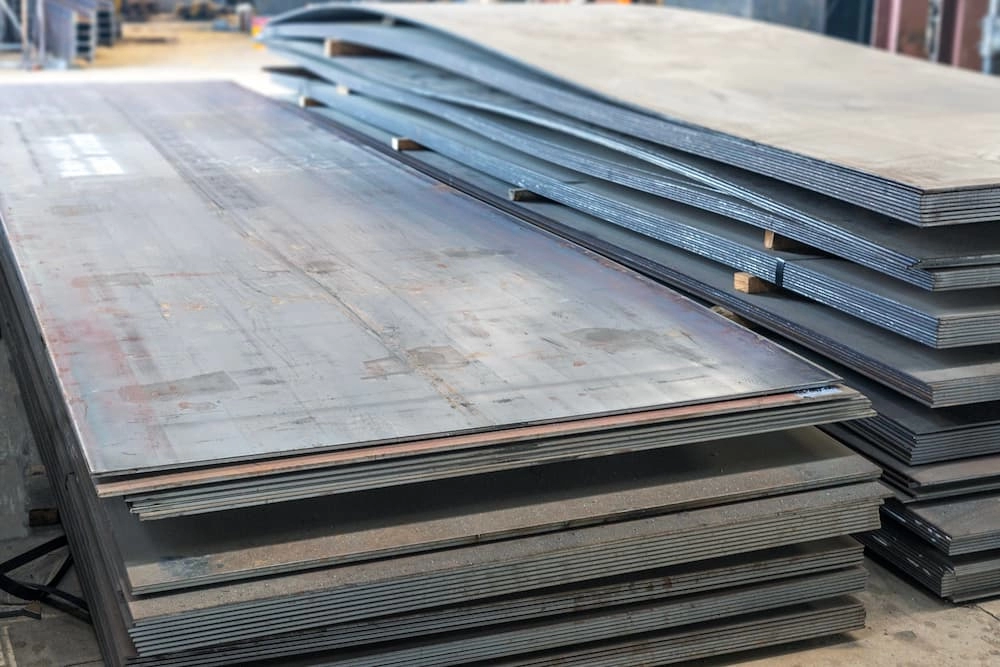
At Vast, we stock a wide range of popular mild steel grades tailored to meet diverse project needs. Here’s a quick look at some of the most common standards and their typical applications:
EN Series
- S235JR: A versatile structural steel with good weldability and machinability. Ideal for general construction, bridges, and light engineering projects.
- S275JR: Offers slightly higher strength than S235, commonly used in structural frameworks, supports, and heavy fabrication.
- S355JR: A high-strength structural steel used in demanding applications like heavy-duty construction, cranes, and automotive components.
ASTM Grades
- A36: The most commonly specified low-carbon steel in the UK, known for excellent weldability and formability. Widely used in building frames, bridges, and general fabrication.
- A283 Gr.C: A low and intermediate tensile strength carbon steel, perfect for applications requiring moderate strength like tanks and general structures.
- A516 Gr.70: Primarily used for pressure vessels and boilers due to its excellent toughness and weldability.
British/Indian Standards
- IS 2062 E250: A widely used steel grade in India and the UK, suitable for construction, structural fabrication, and automotive parts.
- EN8 (C45 equivalent): A medium carbon steel with good strength and wear resistance, often used for shafts, studs, and general engineering components.
Each grade balances strength, ductility, and weldability to match specific industry needs. Whether you’re working on structural steel frameworks or machinery parts, we can supply the right mild steel to fit your project. For machining projects, our comprehensive guide on CNC milling precision can help optimise your process.
Available Forms & Sizes
Mild steel is available in a wide range of forms and sizes to fit almost any project need. Here’s a quick overview:
- Hot-rolled plates & sheets: Great for heavy-duty structural and fabrication jobs where thickness and strength matter.
- Cold-rolled sheets & coils: Offer a smoother surface finish and tighter tolerances—ideal for automotive parts and precise engineering applications.
- Structural sections: Including beams, channels, and angles commonly used in construction and infrastructure.
- Bars: Round, square, and flat bars are perfect for general machining, fabrication, and manufacturing.
- Pipes & hollow sections: Used extensively in construction, mechanical applications, and frameworks requiring strength with less weight.
We stock standard sizes but also offer custom cutting services to meet your exact specifications, ensuring you get the right fit every time without waste.
For projects demanding precision and tailored sizes, our cutting services complement these forms, helping you reduce lead time and material costs. You can also check out how mastering fits and clearances can improve your assemblies for tighter tolerances.
Key Advantages of Mild Steel
Mild steel stands out for its excellent weldability, often requiring no pre-heating, which makes it ideal for quick and efficient fabrication. Its superior formability and machinability mean it’s easy to bend, shape, and machine without cracking or breaking, saving time and effort during manufacturing.
Cost-wise, mild steel is highly competitive compared to alloy or stainless steels, making it the go-to option for projects that require strength without a high price tag. Plus, it’s 100% recyclable, supporting sustainable practices in metal use.
When it comes to appearance, mild steel offers a variety of good surface finish options, including hot-rolled (HR), cold-rolled (CR), galvanised, and pickled & oiled finishes. These surface treatments protect against corrosion and improve the steel’s look, fitting a wide range of uses.
These advantages combine to make mild steel a practical yet versatile choice across many industries and applications.
Main Applications & Industries
Mild steel is a go-to choice across many industries in the United Kingdom because of its versatility and reliable performance. Here are the main areas where it shines:
- Construction & Structural Fabrication: From beams and columns to bridges and building frameworks, mild steel’s strength and weldability make it ideal for structural applications.
- General Engineering and Machinery Parts: Its machinability and ductility suit everything from machine components to industrial equipment.
- Automotive Components: Mild steel is widely used in car frames, body panels, and parts that require good formability and strength.
- Storage Tanks & Pressure Vessels (Non-Critical): It’s great for fabricating tanks and vessels where extreme resistance isn’t needed but durability and ease of manufacture are key.
- Agricultural Equipment: Tractors, plows, and other farming machines benefit from mild steel’s toughness and cost-effectiveness.
- Furniture and White Goods: From metal furniture frames to appliances, mild steel provides strength, smooth finishes, and easy customization.
Its broad application base makes mild steel a cornerstone for industries focused on durable, cost-efficient, and weldable steel solutions.
For those working with machinery components, understanding key factors like geometric tolerance can improve part reliability, which you can explore further in our guide on geometric tolerance for precision engineering parts.
Surface Finishes & Protective Coatings Available
Mild steel comes with several surface finish options to suit different applications and environments. The most common is the mill finish, which is the standard as-rolled surface straight from the mill. For improved cleanliness and better paint adhesion, mild steel can be shot-blasted and primed, providing a good base for further coatings.
For corrosion protection, hot-dip galvanising is widely used, following the BS EN ISO 1461 standard. This process coats the steel with a layer of zinc, making it ideal for outdoor or humid environments where rust resistance is critical.
Painted finishes are also available for mild steel, offering both protective and aesthetic benefits. These can include a variety of primers and topcoats to match your project requirements.
Choosing the right surface finish helps extend the life of your mild steel components, especially in demanding industrial or structural settings. For specifics on handling and finishing, you might find our guide on precision machining and surface preparation useful.
Certifications & Quality Assurance
When it comes to mild steel, quality and compliance are critical. We provide full material test certificates (3.1 MTC) with every batch, ensuring traceability and confirming that the steel meets all specified chemical and mechanical standards. For projects that require legal compliance, our mild steel products come with CE marking and UKCA certification where applicable, guaranteeing conformity with European and UK regulations.
We also welcome third-party inspections to verify quality and specifications, giving you extra peace of mind before you commit to your order. This strong focus on certification and assurance helps our customers meet industry standards for safety and performance consistently.
Why Choose Vast for Mild Steel
When it comes to buying mild steel, Vast stands out for several key reasons tailored to meet your needs quickly and efficiently.
Large Ex-Stock Inventory
We keep a broad range of popular mild steel grades like ASTM A36, S275JR, and IS 2062 E250 ready to ship. This means you get what you need without waiting weeks for restocking.
Next-Day Delivery Across the UK
No long delays—our reliable logistics ensure next-day delivery across the United Kingdom, helping you keep projects on track and avoid costly downtime.
Precision Cutting, Drilling & Profiling Services
Beyond supplying quality mild steel, we offer expert processing including precision cutting, drilling, and profiling. This lets you get your material ready to use right out of the box, saving time and effort.
Competitive Pricing with No Minimum Order
| Feature | Benefit |
|---|---|
| No Minimum Order | Buy as much or as little as you need |
| Competitive Prices | Cost-effective mild steel options |
| Fast Processing | Quick turnaround on custom orders |
Our combination of in-stock availability, fast shipping, and custom processing support makes Vast the smart choice for all your mild steel needs. Whether you’re sourcing structural steel or weldable plates, we’re here to deliver value and convenience.
For detailed welding tips on mild steel, check out our mild steel welding guidelines for best results and material performance.
Technical Downloads Section
To help you get the most from our mild steel products, we offer several handy technical downloads:
| Document | Description |
|---|---|
| PDF Grade Comparison Chart | Quick reference for EN, ASTM, and IS grade equivalents making steel selection easy. |
| Mild Steel Welding Guidelines | Step-by-step tips on welding MS steel for strong, clean joints without extra prep. |
| Weight Calculator Link | Online tool to calculate mild steel weight by size and thickness for precise estimating. |
These resources are designed to support engineers, fabricators, and contractors in choosing, processing, and working with mild steel effortlessly. For example, our detailed welding guidelines ensure you understand why MS steel requires minimal pre-heating, making it ideal for quick, reliable fabrication.
Feel free to use these downloads alongside our product offerings to improve your mild steel projects’ efficiency and quality.
Mild Steel FAQ
Is mild steel the same as low-carbon steel?
Yes, mild steel is often called low-carbon steel. Both refer to steel with a low carbon content (usually below 0.25%), making it flexible, easy to weld, and ideal for general use. Mild steel and plain carbon steel are interchangeable terms in many cases.
Can mild steel rust?
Yes, mild steel can rust if exposed to moisture and air without protection. Since it contains iron, it oxidizes over time. However, protective coatings like galvanising or painting can prevent rust and extend its life.
What is the difference between S275 and S355?
S275 and S355 are common European mild steel grades. The key difference is their strength:
- S275 has a minimum yield strength of 275 MPa
- S355 offers a higher minimum yield strength of 355 MPa
This means S355 can handle more stress and is used where stronger structural steel is required.
Is mild steel magnetic?
Yes, mild steel is magnetic because it is primarily composed of iron, which exhibits strong magnetic properties. This makes it suitable for applications where magnetic response is beneficial.
Can mild steel be hardened?
Mild steel cannot be hardened significantly through heat treatment due to its low carbon content. It’s mainly chosen for its ductility and weldability rather than hardness. However, surface hardening methods like carburising can improve its hardness locally.
For more on machining and finishing mild steel, check out our detailed machining and finishing guide.
 English
  Chinese
  Spanish (Peru)
  German
  Korean
  Spanish (Spain)
  Italian