
Discover how CNC precision engineering delivers sub-micron accuracy, efficient multi-axis machining, and custom solutions for aerospace, medical, and automotive industries.
The Fundamentals What Exactly is CNC Precision Engineering
CNC precision engineering is the advanced manufacturing process that uses Computer Numerical Control (CNC) machines to produce highly accurate parts. At its core, CNC precision engineering combines cutting-edge hardware and software to deliver exact dimensions and complex shapes impossible by hand. The main components include CNC machines, CAD software for 3D modeling, and CAM software that converts designs into toolpaths the machines follow.
The journey of CNC precision engineering began in the 1950s with basic numerical control systems. Since then, it has evolved dramatically, now featuring 5-axis and even 7-axis multi-tool machines capable of intricate operations in a single setup. This evolution has expanded the range of materials and complexities manufacturable with exceptional accuracy.
Key principles drive CNC precision engineering’s reliability. Numerical control automates every step, ensuring consistent repeatability through precise G-code commands. Error minimization is achieved with pre-machining simulations, which detect issues before actual cutting. Together, these fundamentals deliver unmatched precision, efficiency, and quality required in today’s competitive markets.
The Step by Step CNC Precision Engineering Process
CNC precision engineering follows a clear, step-by-step process to ensure every part meets exact standards.
Step 1 Design Phase
This starts with CAD modeling, where the part is designed with exact specs, dimensions, and tolerances. Materials like titanium or specialized alloys are selected based on the part’s requirements. This phase sets the foundation for precision.
Step 2 Programming
Next, CAM software converts the CAD design into machine instructions. This includes generating the toolpaths needed for cutting and planning fixtures or tooling to hold parts securely during machining.
Step 3 Machining Execution
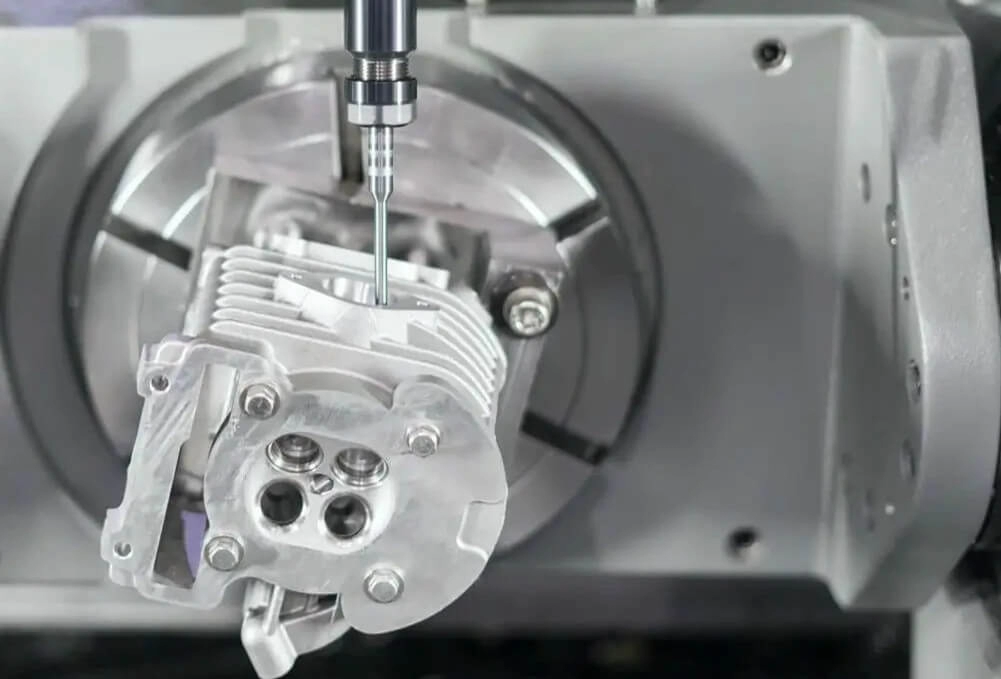
The actual machining happens here on multi-axis CNC machines. Real-time monitoring is critical to minimize vibrations and thermal distortion, which could affect accuracy, especially in tight tolerance machining.
Step 4 Inspection and Finishing
After machining, parts undergo thorough inspection using CMM probing to verify dimensions. Surface treatments like anodizing and polishing are applied. For legacy parts, CNC reverse engineering might be used to reproduce or improve designs.
Challenges Handled
This process tackles challenges like managing complex geometries without redundant multi-stage operations, streamlining production and maintaining precision.
Case Example
At Vast, our streamlined CNC precision engineering process has cut lead times by 40%, improving turnaround while keeping tight tolerances intact.
Key Benefits How CNC Precision Engineering Drives Efficiency and Quality
CNC precision engineering offers clear advantages that boost both efficiency and quality. Here’s how:
Precision and Accuracy
CNC machines work with sub-micron tolerances, delivering precision you just can’t get with manual methods. This means fewer errors and higher-quality parts every time.
Efficiency and Scalability
Operating 24/7, CNC systems run nonstop, helping cut lead times and boost production without sacrificing quality. Plus, with optimized machining, you can reduce material waste by up to 30%, which saves both money and resources.
Cost Effectiveness
By lowering labor needs and speeding up prototyping, CNC precision engineering cuts costs and shortens development cycles. Faster iterations help get products to market quicker without compromising standards.
Versatility
From exotic metals like titanium and high-strength alloys to complex shapes that would be near impossible to create by hand, CNC handles it all. This makes it ideal for industries demanding tough materials and intricate designs.
CNC vs Traditional Methods Comparison
| Factor | CNC Precision Engineering | Traditional Methods |
|---|---|---|
| cURL Too many subrequests. | Sub-micron, high consistency | Larger tolerances, variable |
| Speed | Fast, 24/7 automated operation | Slower, manual labor dependent |
| Cost | Lower per part with volume scaling | Higher labor and error costs |
These benefits explain why CNC precision engineering is a go-to solution in the U.S. manufacturing market, especially for clients looking for reliable, high-quality, and cost-effective production.
Real World Applications Industries Transformed by CNC Precision Engineering
CNC precision engineering has reshaped multiple industries across the U.S., enabling businesses to meet tough standards while improving product quality and efficiency.
Aerospace and Defense
The aerospace sector relies on CNC machining for lightweight titanium components that pass strict FAA and ITAR regulations. These parts need tight tolerance machining to ensure safety and performance in aircraft and defense equipment.
cURL Too many subrequests.
cURL Too many subrequests.
Automotive
cURL Too many subrequests.
cURL Too many subrequests.
cURL Too many subrequests.
cURL Too many subrequests.
cURL Too many subrequests.
cURL Too many subrequests.
cURL Too many subrequests.
cURL Too many subrequests.
cURL Too many subrequests.
cURL Too many subrequests.
Common Pitfalls
- Tool wear: cURL Too many subrequests.
- Thermal expansion: cURL Too many subrequests.
- cURL Too many subrequests. cURL Too many subrequests.
cURL Too many subrequests.
- cURL Too many subrequests. cURL Too many subrequests.
- cURL Too many subrequests. Real-time analysis catches tool wear and deviations before they escalate.
- Design for Manufacturing (DFM) reviews: Early checks on designs ensure machinability and avoid surprises in production.
Best Practices for Reliable Results
- Material selection: Use metals like titanium or specialty alloys suited for the application.
- Iterative simulation: Run multiple CAM and thermal simulations to minimize errors before cutting.
- Compliance: Follow strict standards such as AS9100 to ensure quality and traceability.
Ready to streamline your CNC precision engineering process? Schedule a Vast consultation today for a customized audit and expert guidance.
The Future of CNC Precision Engineering Innovations on the Horizon
CNC precision engineering is gearing up for big changes. We’re seeing AI integration becoming a game-changer, especially for predictive maintenance. This means machines can anticipate issues before they happen, cutting downtime and keeping production smooth. On top of that, hybrid CNC and 3D printing technologies are merging to offer new ways of building parts—combining precision machining with additive processes for faster, more complex designs.
Sustainability is also a growing focus. Using eco-friendly and lightweight materials not only helps reduce environmental impact but also boosts performance, especially in industries like aerospace and automotive.
At Vast, we’re investing heavily in 7-axis CNC technology. This next-generation approach gives us unmatched precision and flexibility, letting us handle the most complex parts quickly and with tight tolerances. It keeps us ahead in providing local U.S. manufacturers with top-quality parts that meet evolving standards.
Looking ahead, these innovations make local manufacturing more resilient—especially important as supply chains shift post-2025. By adopting advanced CNC precision engineering methods, U.S. businesses can reduce dependency on external sources and respond faster to market demands, ensuring a strong, homegrown manufacturing future.
 Italian
  English
  Spanish (Peru)
  German
  Korean
  Spanish (Spain)